Dexter Studios Wins Award at CASAXR 26, the World’s Longest-Running Computer Animation Conference “Highly Praised for AI-Powered Motion Search Technology with 99% Accuracy”
Dexter Studios showcased its world-class technological prowess by winning an award at the longest-running international conference in the field of computer animation.
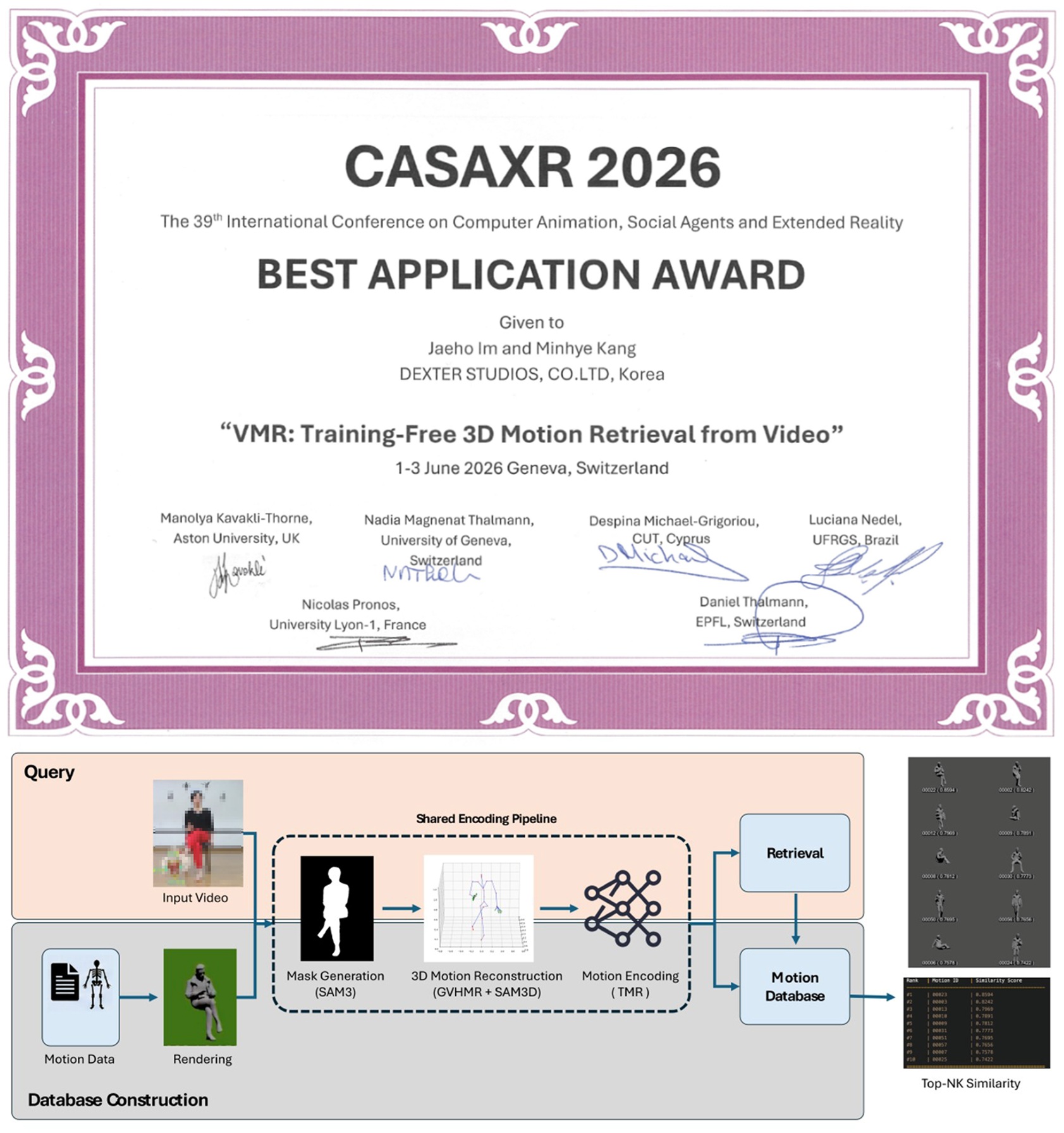
Dexter Studios(206560; hereinafter “Dexter”), a company specializing in content creation, announced that it presented a research paper on AI-based 3D motion retrieval technology at “CASAXR 26” held in Geneva, Switzerland. Dexter’s paper received widespread critical acclaim and won the “Best Applied Technology Award.” It is also scheduled to be published in CAVW (Computer Animation and Virtual Worlds), an academic journal issued by Wiley, a global academic publishing house with a 200-year history.
CASAXR (formerly CASA) was founded in 1988 under the leadership of the Computer Graphics Society (CGS) as the world’s very first academic conference dedicated to computer animation. Celebrating its 39th event, it is an international forum boasting the longest history and highest authority in the world, representing the fields of virtual humans and computer animation. In line with the rapid growth of extended reality (XR), the conference officially changed its name to “CASAXR” starting this year by adding “XR” to its original title. By transforming into a future-oriented AI and immersive technology conference, it successfully drew intense attention from both academia and tech enterprises.
Dexter presented its paper titled “Training-Free 3D Motion Retrieval from Video (VMR).” The core content involves the development of a technology where, if a user wants to find a specific 3D movement within a motion capture database, they can simply input a sample video instead of searching with a combination of text keywords. The AI then analyzes the dynamic characteristics of the video to locate the most similar 3D motion data. Moving away from the conventional AI model approach that requires describing movements through subjective expressions, this technology enables intuitive searches using just a single video containing the movement.
In performance evaluations using academic standard datasets, this technology recorded an accuracy rate of 99.66%. This significantly outperforms the text-based AI model (77.48% accuracy) developed by Germany’s Max Planck Institute for Intelligent Systems, a renowned institution that established the global standard for the virtual human sector. Even when processing videos from entirely different visual domains—such as YouTube fancam videos, 2D animations, and AI-generated videos—the system filters out all other elements and deciphers solely the essence of the movement, deriving precise search results with a similarity score of 0.899 or higher. Furthermore, even if a completely new movement with no exact matching motion in the database is entered, it identifies the closest alternative movement with a high average similarity score of 0.927. Since similar 3D motions that can be immediately utilized in projects with only minor modifications are retrieved, production efficiency can be maximized.
Another distinct feature is the adoption of a “Modular Pipeline” architecture, which organically combines pre-verified, high-performance modules instead of training and building a complex, single AI model as a whole. Each module is separated into distinct tasks, such as target person separation, 3D motion reconstruction, and motion retrieval, allowing specific modules to be replaced independently. It is a “Training-Free” AI model that can immediately apply newly released open-source models that are updated frequently without separate system development, and it incurs no data re-training costs even when upgrading to the latest models.
With the development of this technology, creators can instantly find and repeatedly utilize vast amounts of structured 3D motion data when producing digital content such as movies, games, and VR (Virtual Reality), thereby maximizing the asset value of existing databases. Since physically accurate motion data can be utilized right away, it secures higher operational efficiency compared to setting up new motion capture sessions or utilizing error-prone, AI-generated motions through extensive post-processing.
“This is a prime technological use case that secures unparalleled operational performance while simultaneously building a modular pipeline that can be frequently updated using the latest open source,” said Jae-ho Lim, Vice Director of Dexter’s R&D Center, who presented the paper. “Our pioneering AI technology development is not only increasing the efficiency of our production pipeline but also enhancing the utility of the high-quality databases that Dexter possesses.”
 ⓒ Dexter Studios


