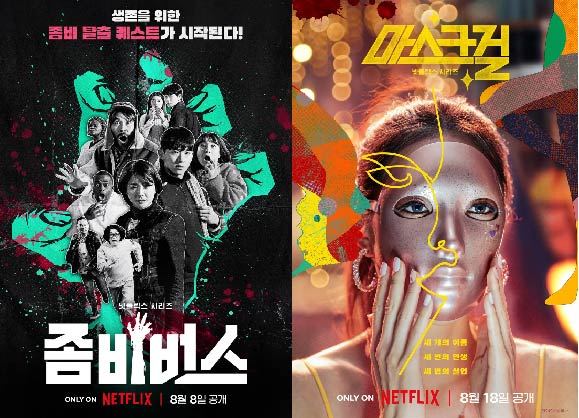
Dexter Studios continues to work with Netflix to expand its portfolio.
Dexter Studios (206560), a company specializing in VFX and content production, announced on August 21 that the company was indeed given the reigns to apply its VFX technology to Netflix’s entertainment show “Zombievers” (produced by Kakao Entertainment, directed by CP Jinkyung Park and PD Moon Sang-don). According to the company, Zombieverse marks the first entertainment program to get Dexter Studios’ VFX technology. Dexter Studios also worked on the DI (digital intermediate) aspects of the project to make the series look completely different from other entertainment programs and produce an exciting environment featuring zombies that look as real as they get.
Meanwhile, Dexter Studios’s subsidiary Livetone was busy behind the scenes taking care of the DI&DIT (digital intermediate & digital imaging technician) work for Netflix’s latest series “Mask Girl,” which was released on August 18. Livetone designed the sound for “Mask Girl” to build up its ambiance as an action-thriller and drama series.
“Zombieverse” is an entertainment program where the cast must survive while performing quests in the Seoul area, which has suddenly turned into a zombie colony. Immediately upon its release on August 8, “Zombieverse” skyrocketed to first place in “Today’s Top 10 Series in Korea” and recorded 1.9 million views (viewing time divided by the total running time of the work) over the next six days. It also ranked fifth in the top 10 Netflix global series (non-English category). In particular, “Zombieverse” proved to be a massive hit in 13 different countries, including Korea, Mexico, Peru, Ecuador, Singapore, Hong Kong, Taiwan, Thailand, and Vietnam.
Supervisor Seo Byeong-cheol, in charge of the VFX that went into “Zombieverse,” said, “We worked on our zombies as efficiently and meticulously as possible to clearly show the audience what the world view behind the series.” He explained, “We tried to keep in line with what the pre-planned parts of the production were trying to do and the more spontaneous parts of the production that happened during the actual filming.” Seo added, “We had people actually mimic the movements of a zombie, recorded them, and processed them with digital data to make sure our zombies looked more ‘realistic’ and natural. We applied VFX to how the zombies looked as well to produce a final product that looked more complete.”
Meanwhile, “Mask Girl,” based on a webtoon series of the same title from 2015, made headlines when news of a new televised series based on the original webtoon was coming down the pipeline. “Mask Girl” tells the story of Kim Mo-mi (actors Go Hyun-jung, Nana, Lee Han Byeol), an ordinary office clerk lacking confidence in her physical appearance, who covers her face with a mask every night and then unintentionally gets caught up in an accident while hosting an internet broadcast. With its solid storyline and suspenseful plot, “Mask Girl” garnered plenty of attention even before Netflix released the series.
Park Jin-yeong, the colorist who led the digital intermediate work for “Mask Girl,” pointed out what the audience should look for when watching the series. Park said, “This series, which has seven episodes, has a variety of different colors, textures, and contrasts in each episode to help viewers understand what’s going on and to keep them interested in each episode.” She added, “In the sequence where the light illuminates the room belonging to Joo Oh-nam, a reclusive loner obsessed with Kim Mo-mi, we tried to use deep and dark colors to create a dimly-lit and stuffy atmosphere. We also tried to show just how deep Oh-nam’s obsession with Mo-mi ran with his intense gaze looking at Mo-mi from his desk and through his computer. That’s why we adjusted the surrounding setup to make it as if his room was draped with blackout curtains.”
Park continued, “On the opposite end of the spectrum, in the sequence where Mo-mi gets up on the stage after plastic surgery, we tried to use bolder colors, including red, to highlight her presence. The way she walks up the red carpet with cameras flashing in the background really grabs your attention. Here, we also used yellow to give stability and matched the brightness for consistency in terms of how the perspectives of a third party intersect with Mo-mi’s own.”
Kim Byeong-in, the sound supervisor in charge of “Mask Girl’s” sound design, said, “In order to make each episode feel like its own stand-alone product, we added various sound effects and music with different vibes. On the other hand, we used new technology to add consistency between different sequences starring Mo-mi performed by three different actors.” Kim continued, “But we did refrain from using violent sound effects, such as the sound of swords, as much as possible so that Mo-mi’s emotions would feel much closer to the surface.”