
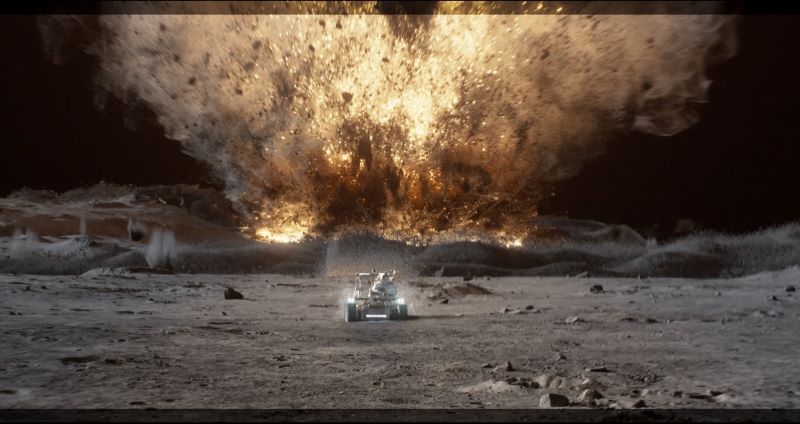
One notable sequence from the movie is the meteor shower and impact explosion produced using VFX technology. The shock wave caused by the explosion from a massive meteor shower shook the entire surface of the moon with massive amounts of energy rushing toward the stranded astronaut. The sequence is a critical part of the film that heightens the sense of crisis for Seon-woo (actor Do Kyung-soo).
Korea’s first director with two films selling 10 million tickets at the box office, Kim Yong-hwa, is back with his latest movie, “The Moon.” Dexter Studios, previously known for its mesmerizing rendering of the afterlife with the fantasy series “Along with the Gods” back in 2017, is once again offering audiences a new experience in the science-fiction genre.
Dexter Studios (206560), a company specializing in VFX and content production, announced on August 2 that the film “The Moon” (distributed by CJ ENM), in which Dexter worked on the VFX, has been officially released. In May 2021, the company announced its participation in the project by sharing the news of its new VFX technology supply contract worth KRW 6 billion with production company Blaad Studios. Also, as a production partner, Dexter Studios joined the project as an investor.
“The Moon” is about former Space Center director Jae-guk (actor Sol Kyung-gu) and NASA’s director of manned lunar orbiters Moon Young (actor Kim Hee-ae) trying to save astronaut Seon-woo (actor Do Kyung-soo), who was stranded on the moon 384,000km away from Earth after an unexpected accident.
Dexter Studios Supervisor Jin Jong-hyeon, who oversaw the VFX that went into “The Moon,” said, “Due to the nature of the genre, this movie was designed with original visuals. We tried to eliminate any factual errors while using our imagination rooted in scientific facts.” Jin explained, “This allows audiences to fully immerse themselves into the environment we’ve created and the events that place in space, which is a place we can’t go and experience ourselves in real life.”
The way Dexter Studios recreated the ambiance in space is a product of countless hours studying the scientific composition of space itself. The universe appears inky black because there is virtually no substance that emits bright light except for stars. That is why, in order to realistically render the true darkness of space in the film, Dexter Studios wrapped the entire production studio with black cloth that does not reflect light in order to prevent the distortion of light. Dexter also captured the sense of vastness of space by eliminating most sources of light – only the spacecraft and lunar rovers either emitted or reflected light.
Jin explained how much time he spent thinking about “light.” He said, “In the film, sunlight has a direction to it. It also creates two different sides – a bright side and a dark side.” Jin added, “The position of the sun serves as a reference point. We wanted to add depth and texture to space using the contrast in brightness and darkness created by the light we were able to use.”
The same principles applied to how the moon itself looked. Jin said, “The moon, which is where the juiciest parts of the story are told, has roughly 16% of the gravity we have on Earth. And it doesn’t have any air. So, we tried to design explosions and the way objects would collide on the moon looking at various science journals and actual footage from the moon to add more tension and excitement.”
He also recalled that as a VFX supervisor, he tried his best to apply what he had learned from scientific analysis to various VFX elements. Jin explained, “If you drop a feather and a bowling ball at the same time in a vacuum, they fall at the same speed. But on Earth, we know that a feather would fall much slower than a bowling ball because of gravity and air resistance.” He added, “If a meteor shower falls on Earth, a huge dust cloud can completely blot out the sun. But the conditions are different on the moon. And that’s why we had to make things look drastically different from how they do on Earth.”
Jin continued, “We kept things much clearer on the moon so that the audience could see what was going on, and that created completely new visuals for the moon we created compared to Earth. In particular, the way the lunar module’s thrust blows dirt around and the way the lunar rover kicks up dust were all based on the same mechanism.” VFX was used extensively throughout the entire film, including in the Naro Space Science Center’s situation room, inside NASA, inside the spacecraft, and on the surface of the moon, to deliver a more visually immersive experience.
Meanwhile, in addition to VFX, Dexter Studios also took charge of overall video technology, including virtual production (VP) and digital intermediate and digital imaging technician (DI&DIT) duties, and even brought in its subsidiary Livetone to design the sound effects, all in an attempt to improve the quality of the final product. Expectations also grew with news that Dexter Studios was using in-camera visual effects (ICVFX) and VP technology, which plays VFX images on an LED screen to serve as a backdrop, for the first time in a Korean film.
Kim Wook and Kang Jong-ik, co-CEOs of Dexter Studios, said, “Korea has been somewhat of a graveyard for home-grown sci-fi movies, which is why investors and creators are hesitant to take a shot at a sci-fi project in the first place.” Both continued, “We think ‘The Moon’ is a massive step forward for the Korean film industry in that a production company, distributor, and various technicians worked together to produce a genuine sci-fi film for the big screen.”
They explained, “Due to the nature of the project, ‘The Moon’ required highly difficult technical elements, and a large number of our artists were brought in to create the visuals we needed in video. We hope we can invite more people to be on the lookout for sci-fi content made in Korea given how we’ve worked to deliver a whole new experience for our audience.”


