Dexter Studios(206560, hereinafter “Dexter”), a leading comprehensive content studio, has once again demonstrated its global technological competitiveness at SIGGRAPH 2026, the world’s most prestigious international conference and exhibition on computer graphics and interactive techniques.
Dexter announced that it attended SIGGRAPH 2026 in Los Angeles, USA, to share its latest in-house R&D achievements. SIGGRAPH is the world’s largest and highest-level international forum where cutting-edge research and production techniques in computer graphics (CG), visual effects (VFX), animation, and interactive technologies converge. This year’s event drew global tech giants and leading studios, including NVIDIA, Disney, Pixar, and Adobe, alongside major VFX houses and research institutions to share next-generation technologies and production know-how.
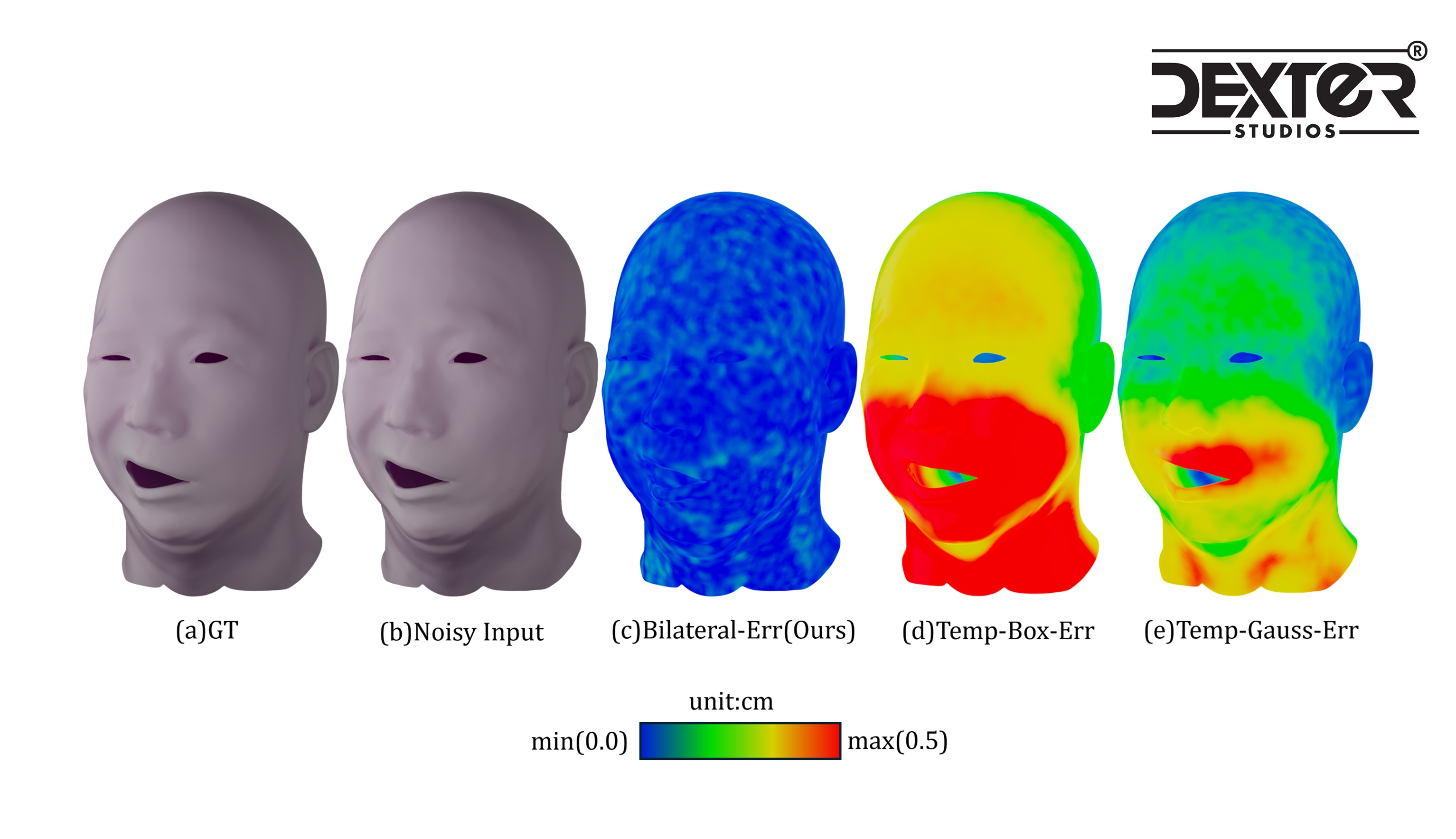
At this year’s conference, Dexter earned significant recognition for its technological sophistication and research value through its paper, “Motion-Faithful Denoising for Dynamic Facial Scan Sequences.” 4D facial scanning is widely used in VFX for films and dramas, as well as in animation, to convert an actor’s live facial expressions into precise digital data. The more detailed the data captured, the more lifelike the resulting digital human becomes. Dexter’s latest research introduces a novel denoising technique that effectively removes visual noise from 4D facial scan data used in VFX production while fully preserving the actor’s subtle expression changes and intricate facial details.
4D facial scan data is time-varying 3D facial data, capturing an actor’s performance through dynamic, three-dimensional scans dozens of times per second. However, during this high-precision scanning process—which runs up to 60 frames per second—microscopic noise inevitably occurs. Conventional denoising methods often smooth out the noise at the expense of losing fine details in the facial expressions. To overcome this limitation, Dexter developed a “motion-adaptive bilateral filter.” This filter adaptively denoises data based on the speed of facial movements, maintaining temporal consistency across frames while perfectly preserving the realistic details of the actor’s performance. The method achieved an approximate 76% reduction in noise compared to existing technologies, receiving enthusiastic responses from both academia and the VFX industry.
As the first company in South Korea to independently develop and operate 4D facial scanning equipment and systems, Dexter has utilized this technology to create high-fidelity digital humans, mapping an actor’s high-precision performance data onto virtual characters for movies and dramas. Recently, the studio patented a 4D facial scan data editing technology that allows for the precise modification of facial expressions while perfectly maintaining natural head movements, such as nodding or tilting. This further solidifies Dexter’s proprietary ecosystem, spanning from equipment buildout and data acquisition to advanced editing.
Dexter has consistently proven its technological prowess on the global stage at SIGGRAPH. The company showcased digital human footage at the SIGGRAPH Computer Animation Festival in 2015 and presented a research paper on its proprietary software, ZENN, in 2017. It also shared research achievements in virtual production and VFX at SIGGRAPH Asia in 2019 and 2022, and presented OpenUSD-based VFX pipelines and virtual production case studies at SIGGRAPH 2024, continuously fostering global technological exchanges.
“Participating in SIGGRAPH 2026 is highly meaningful as we shared the technology and R&D capabilities accumulated through actual content production on the world’s top stage, proving Dexter’s technological edge once again,” said Jaewon Song, Head of Dexter Studios R&D Center. “Moving forward, we will continue to drive technological innovations that can be directly applied to production environments while leading the global content market.”
 ⓒ Dexter Studios


